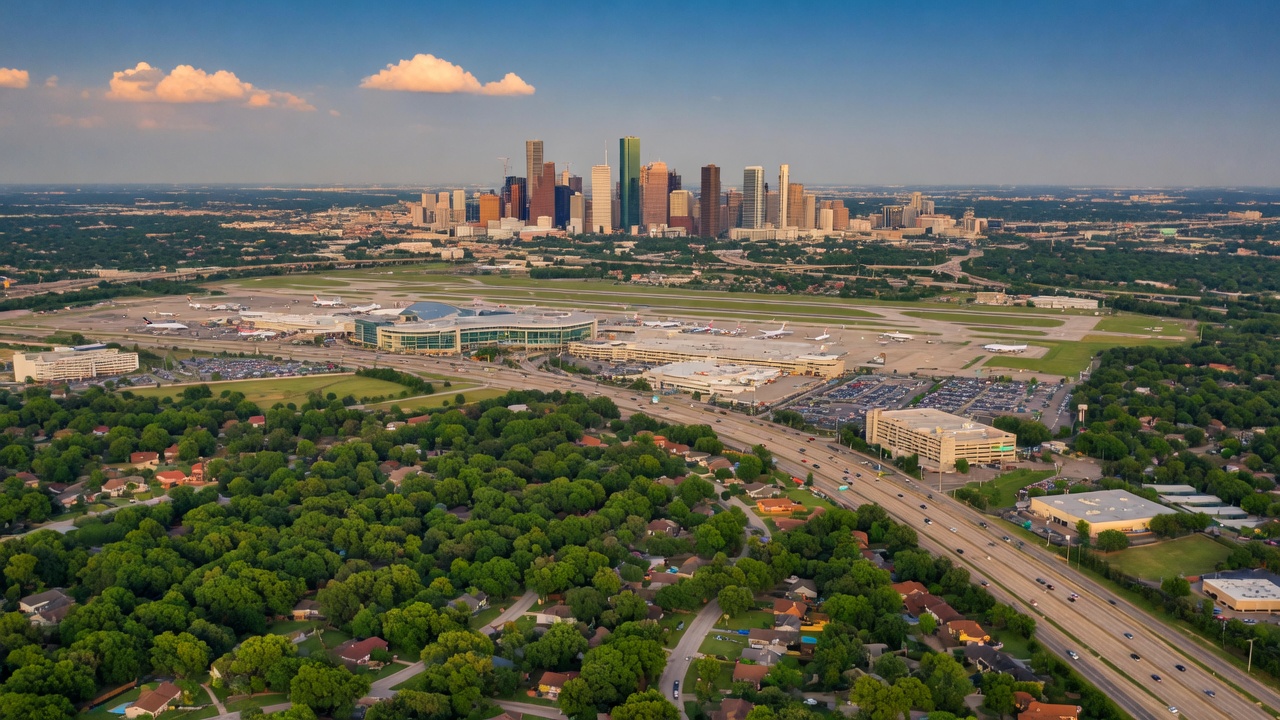
Houston (IAH)
Diane's home base. She represents pilots relocating anywhere in the Houston metro, from Kingwood to Katy, Humble to The Woodlands. She knows these neighborhoods, the schools, and the commute to IAH down to the minute.

Why Diane understands this decision
I share daily life with an airline captain. I understand the pilot world from the inside: the schedule, the seniority math, the short-call premium, the quality-of-life trade-offs that don't show up in a spreadsheet.
I bring structured, analytical thinking to the move-vs.-commute decision. Seniority position, family needs, financial picture, quality of life. They all factor in, and none of them have a single right answer.
Houston offers no state income tax and a cost of living that lets pilots build equity without sacrificing lifestyle. I know the neighborhoods across the metro because I have spent years helping pilot families settle into them. The commute patterns, the school districts, the grocery store runs, the after-school routines. I know what works and what creates friction over time.
For pilots heading to Houston, you get me directly. I know these neighborhoods, schools, and commute patterns across the metro. And for pilots moving to or from other bases, I stay involved and make sure you're taken care of, start to finish.
IAH Shortlist
Not sure which Houston areas actually fit your schedule, budget, and family priorities?
Tell me what matters most and I'll narrow IAH to the areas worth seeing, matched to your schedule and budget. No guesswork and no generic list.
Base Overview
Houston: The largest airline hub
George Bush Intercontinental Airport (IAH) is the largest airline hub and one of the busiest airports in the world. Houston is a base with deep seniority, strong trip coverage, and a housing market that remains more affordable than Chicago, Newark, San Francisco, or Los Angeles. For pilots who value space, good schools, and a lower cost of living, Houston is a strong position.
The Houston metro spans over 10,000 square miles with approximately 60+ distinct neighborhoods, and the right choice depends on your commute tolerance, family needs, and lifestyle priorities. Pilot families are spread across the metro, from Kingwood and Atascocita northeast of IAH to the Katy corridor west of downtown, from The Woodlands north of the city to Cypress and Spring in the northwest. The key is matching the neighborhood to your specific situation.
Texas has no state income tax, which is a meaningful financial advantage. Property taxes are higher than the national average, but the combination of no income tax, lower home prices, and strong trip availability makes Houston one of the most financially favorable bases for pilots.
Quick Facts
- IAH - Major hub
- No state income tax
- 15–25 min to IAH from Kingwood
- Humble ISD, Katy ISD, and others
- Full Houston metro coverage
Diane knows Houston
Deep knowledge of every neighborhood, school district, and commute pattern across the Houston metro.
Request consultation
The decision that comes before the house
Before you start looking at neighborhoods, there is a bigger question worth thinking through: should you move to base at all?
The trade-off is straightforward. A pilot living in base can accept short-call assignments that a commuter physically cannot. When your phone rings with a short-call assignment, you roll out of bed and go to work. That is real money, and it compounds over a career. The short-call premium, the ability to pick up high-value trips on short notice, the flexibility to say yes when others have to say no. Living in base is a revenue position.
But moving to base also means uprooting. Leaving a community you have built, pulling kids from schools, starting over in a new city. For some pilots the math clearly favors the move. For others, the quality of life they have where they are outweighs the financial upside of being in base.
There is no default answer here. Some pilots clearly benefit from the move, while others find that staying put and managing the commute is the right call. The decision depends on your seniority, your family situation, your financial goals, and what you are willing to trade.
Diane walks pilots through this decision with honest analysis, not a sales pitch. Sometimes the right answer is to move. Sometimes it is not. Either way, you want to make the choice with clarity, not pressure.
Neighborhoods
Where pilots live in Houston
Houston is a big metro, and pilot families settle across a wide area. These are the neighborhoods that come up most often, roughly organized by distance and drive time to IAH. Every one of them is a viable option. The right one depends on your priorities.
Kingwood
Kingwood is an established, master-planned community built around Lake Houston. Known as the "Livable Forest" for its mature tree canopy, it offers strong schools within Humble ISD, walking trails, and a neighborhood identity that families tend to appreciate. The Kings Point area has a community lake, trail system, and everyday conveniences close by.
A typical Tuesday for a Kingwood-based pilot family: the pilot wakes at 5:15 AM, makes coffee, and is in the car by 5:30. The drive to IAH is 18 minutes via the Hardy Toll Road or West Lake Houston Parkway. Through security by 6:05, at the gate by 6:15, well ahead of a 6:30 report. The spouse handles morning school drop-off. Kingwood High School or Kingwood Park High School, both part of Humble ISD, start at 7:25 AM. After drop-off, there is time for a run on the trails, coffee at one of the shops in Town Center, or a few hours of focused work.
Groceries are easy. H-E-B on Kingwood Drive is the anchor, and there is a Kroger nearby as well. The restaurants are local, not chain-heavy, and Kingwood has a community identity that you feel when you attend a Friday night football game or walk through the farmers market on a Saturday morning. Home prices typically range from $360,000 to $430,000 for a family home, with the upper tier closer to $490,000 to $500,000 for newer construction or waterfront properties. The commute is short. Kingwood is the choice for pilots who want the full package and are willing to invest in a community that gives back.
The Woodlands
The Woodlands is a master-planned community north of Houston with a well-earned reputation for excellent schools through Conroe ISD, walkable town centers, and a family-oriented environment. It is one of the more upscale options in the Houston metro, and it draws a fair number of captains and senior first officers who want the combination of good schools and proximity to nature.
A typical week in The Woodlands: the pilot leaves at 4:50 AM and budgets about 35 minutes to IAH via the Hardy Toll Road. It is one of the longer commutes, and it is the main trade-off of living here. The spouse handles school drop-off at one of the highly rated Conroe ISD campuses. After school, the family might have dinner at one of the restaurants along the Waterway, attend a concert at The Cynthia Woods Mitchell Pavilion, or bike the more than 250 miles of trails. H-E-B, Whole Foods, and Kroger serve the Village and Market Street areas. Everything is close, and everything is well-maintained.
The Woodlands also offers more lock-and-leave options than the other neighborhoods. Townhomes, condos, and patio homes are available for pilots who want minimal maintenance and a turnkey setup when they are away on trips. The drive to IAH is straightforward via I-45 and the Hardy Toll Road, typically 26 to 35 minutes depending on the time of day. Pilot schedules generally avoid peak traffic, which helps. The Woodlands is a good fit for families who want a polished, well-maintained community and are comfortable at the higher end of the Houston price range.
Katy
Katy sits west of Houston along I-10 and has grown into one of the metro's strongest family communities. Katy ISD is consistently rated among the better school districts in Texas, and the area offers a wide range of housing across mature master-planned communities. Cinco Ranch, Seven Meadows, and Grand Lakes are the names that come up most often in pilot conversations. Each offers amenities, well-maintained homes, and a strong sense of community.
The commute to IAH is the longest of the neighborhoods on this list, typically 45 to 60 minutes depending on traffic patterns. On a weekday morning or during the afternoon rush, it can push to 70 minutes or more. Toll roads, specifically the Grand Parkway and the Hardy Toll Road, provide a more reliable but more expensive route. For a senior captain with a predictable line, the trade-off is manageable. For a pilot on reserve who could get a short-call assignment, the distance introduces stress.
A typical week in Katy: the pilot is up by 4:00 AM for a 6:00 AM report, accounting for the longer drive. The spouse handles school drop-off at one of Katy ISD's strong campuses. After school, the kids have activities at the community sports complexes or neighborhood parks. Katy's restaurant scene along I-10 is diverse and growing. H-E-B and Kroger locations are plentiful. Home prices range from $330,000 to $450,000 for a typical family home. Katy is a good fit for families who prioritize schools and community and are comfortable with a longer commute.
Cypress
Cypress is northwest of Houston and has been one of the fastest-growing areas in the metro. Much of the construction is newer, with modern master-planned communities offering good value relative to the square footage and finishes you get. Schools are part of Cy-Fair ISD, one of the largest districts in Texas.
The drive to IAH runs via US-290 and the Hardy Toll Road or Beltway 8, typically 30 to 45 minutes. Cypress is popular with younger families and new hires who want newer construction and a good price point. The trade-off is that it is still developing, and some areas are more established than others.
Atascocita / Humble
Atascocita and Humble sit just south of Kingwood and offer some of the shortest commutes to IAH. The area has grown quickly with newer retail along the FM 1960 corridor, good access to Lake Houston, and a mix of housing stock ranging from established subdivisions to newer builds. It is part of Humble ISD.
A typical week in Atascocita: the pilot leaves the house at 5:20 AM and arrives at IAH in approximately 17 minutes. The schools, also part of Humble ISD, are newer and well-rated, with Atascocita High School and Atascocita Middle School serving the core neighborhoods. After school, the kids might have practice at one of the community sports complexes, or the family might head to the Atascocita Park trails for an evening walk. Groceries happen at the H-E-B on FM 1960 or the newer retail developments along West Lake Houston Parkway.
The proximity to the airport is the main draw. The FM 1960 route to IAH can be as short as 15 to 20 minutes during off-peak hours. For pilots who prioritize a short drive to base, particularly those on reserve or with unpredictable schedules, Atascocita is worth a close look. The price points are also more accessible than Kingwood or The Woodlands.
Porter
Porter is for pilots who want room to breathe. East of Kingwood along the FM 1314 corridor, Porter offers larger lots, lower density, and a more rural character. Many homes sit on half-acre or larger lots, with mature trees, outbuildings, and a quiet that you do not find closer to the airport.
A typical week in Porter: the drive to IAH takes 20 to 30 minutes, depending on your exact location. It is a straightforward commute along FM 1314 to the Hardy Toll Road. The schools are primarily New Caney ISD, with some areas served by Humble ISD. New Caney is smaller than Humble ISD and offers a more intimate setting. The kids attend school with smaller class sizes, and the community has a small-town dynamic where people know each other. Groceries require a trip into Kingwood or Atascocita for the larger stores, though basic necessities are available in Porter. The family might spend a Saturday afternoon at one of the lake access points or working on the property.
Home prices range from $315,000 to $430,000, with newer construction offering generous square footage at competitive prices. Porter is the choice for pilots who value privacy, space, and a slower pace of life. The commute is a few minutes longer, but the trade-off in quality of life is significant for the right family.

New Caney
New Caney is the most affordable option in the area, with home prices typically ranging from $295,000 to $315,000. It is further from IAH than the other communities covered here, with a commute of 25 to 35 minutes, but for pilots who prioritize affordability and a rural setting, the trade-off is worth considering.
New Caney has seen significant growth in recent years, with new retail and restaurant options following the residential expansion. The community retains a small-town character that many families appreciate. The schools are served by New Caney ISD, and the area offers a quieter, more spread-out lifestyle than the master-planned communities closer to the airport.
For new hires who are watching their finances carefully, or pilots who prefer a more rural setting with lower housing costs, New Caney provides a genuine option. The commute is longer, but it is still manageable, and the savings on housing can be significant.
Spring
Spring is northwest of Kingwood and north of the Hardy Toll Road, close to IAH. The neighborhoods here are older and more established than the newer developments in Cypress or Porter, with mature trees and larger lots in many areas. Spring ISD and Klein ISD serve different parts of the community.
The commute to IAH is among the shortest from any of the neighborhoods on this list, often 20 to 25 minutes. Spring is a practical choice for pilots who want to keep housing costs lower while staying close to base. It is a good fit for new hires, pilots on reserve, or anyone who values a short, predictable drive to the airport over a newer or larger home.

IAH Shortlist
Not sure which Houston areas actually fit your schedule, budget, and family priorities?
Tell me what matters most and I'll narrow IAH to the areas worth seeing, matched to your schedule and budget. No guesswork and no generic list.
Cost of living advantage
Houston is one of the most affordable airline bases. The combination of no state income tax and lower home prices creates a meaningful financial advantage over Newark, San Francisco, Chicago, or Los Angeles. Median home prices near IAH, where Kingwood, Atascocita, and Humble sit, run $350,000 to $400,000, well below comparable communities near other major bases.
- No state income tax on pilot earnings, typically saving airline crew $5,000 to $15,000 or more per year depending on bracket, compared to Illinois, California, New Jersey, or New York.
- Median home prices 30-60% below San Francisco and Los Angeles, and 20-40% below Chicago and Newark.
- Property taxes typically run 1.6% to 1.8% annually, which is one of the highest rates in the country, but no state income tax offsets the difference.
- Lower insurance costs than coastal California or urban Northeast, though flood insurance matters near some areas.
Commute to IAH
The commute from most Houston neighborhoods to IAH is manageable, especially during the off-peak hours when pilots typically report for duty. Most communities on this list offer a 20-to-40-minute drive.
- Early morning reports: 18-25 minutes from Kingwood or Atascocita. Minimal traffic at those hours.
- Late night returns: 20-30 minutes. Hardy Toll Road avoids construction zones.
- Rush hour (7-9AM, 4-6PM): 35-50 minutes. Most pilot schedules avoid these windows.
The key difference: you drive yourself. No connection flights, no overnight airport sits, no commute stress that comes from being a passenger. Living in base means you leave home and arrive at the airport, ready to work.
What makes Houston unique for pilots
Deep seniority and trip availability
IAH is one of the largest bases, which means strong trip trade, good coverage, and options across equipment types.
Financially favorable tax structure
No state income tax. Lower cost of living. Your captain's paycheck goes further in Houston than at almost any other base.
Strong school districts
Humble ISD, Katy ISD, Cy-Fair ISD, Conroe ISD, and others provide quality public education across the metro.
Quality of life
Lake Houston, outdoor recreation, established communities with mature trees, and proximity to downtown Houston for culture and dining.
Ready to explore Houston?
Diane provides strategic guidance for pilots relocating anywhere in the Houston metro. No pressure, just honest analysis.