
It was 2 AM when Jim got the call. Two short-call assignments had just posted with a 6 AM report time. He was home, twenty minutes from the airport. He took them both, picked up the trips, and went back to sleep. By the time he was through security that morning, he had already earned a premium that a commuting pilot could not have captured from three states away.
That story is one I come back to often, not because it is unusual, but because it is completely ordinary for a pilot who lives in base. For a commuting pilot on reserve, the same night looks fundamentally different. The question is not whether you would take the premium trip. The question is whether you can physically get to the airport in time to take it. Most of the time the answer is no.
Reserve life is a topic every pilot understands in principle, but the experience of it diverges dramatically depending on where you sleep at night. If you are a new hire just reaching mainline or a pilot considering a base trade, the difference between commuting on reserve and living in base on reserve is one of the most important things to understand before you decide where to live.
How reserve works in practice
Reserve means you are on call. Your airline assigns you a set of reserve days each month, and during those days you must be able to report to the airport within a specified window. The exact callout time is defined by your collective bargaining agreement, but the structure is consistent across the majors. You are expected to be ready, rested, and within reach of the airport during your reserve window.
For an in-base pilot, this is manageable. You live within a reasonable drive of the airport. You can maintain a normal schedule on your days off, run errands, spend time with family, and still be confident you can meet the callout. The reserve window is a constraint, but it is a constraint that fits inside a normal life.
For a commuting pilot on reserve, the same constraint changes everything. You cannot be at home three states away and still meet a short callout. So you have to position yourself near the airport. That means a crash pad, a hotel, or a buddy's spare room in the base city. You are not living your normal life during reserve days. You are living in limbo, waiting for a phone call that may or may not come, while your family is somewhere else entirely.
The crash pad reality
A crash pad near a major base typically costs between $200 and $500 per month, depending on the city and proximity to the airport. In Newark, pads can run $350 to $700. In Chicago, $230 to $600. In San Francisco, $395 to $450. These are the monthly rates for a shared room, often with multiple crew members rotating through bunks on different schedules.
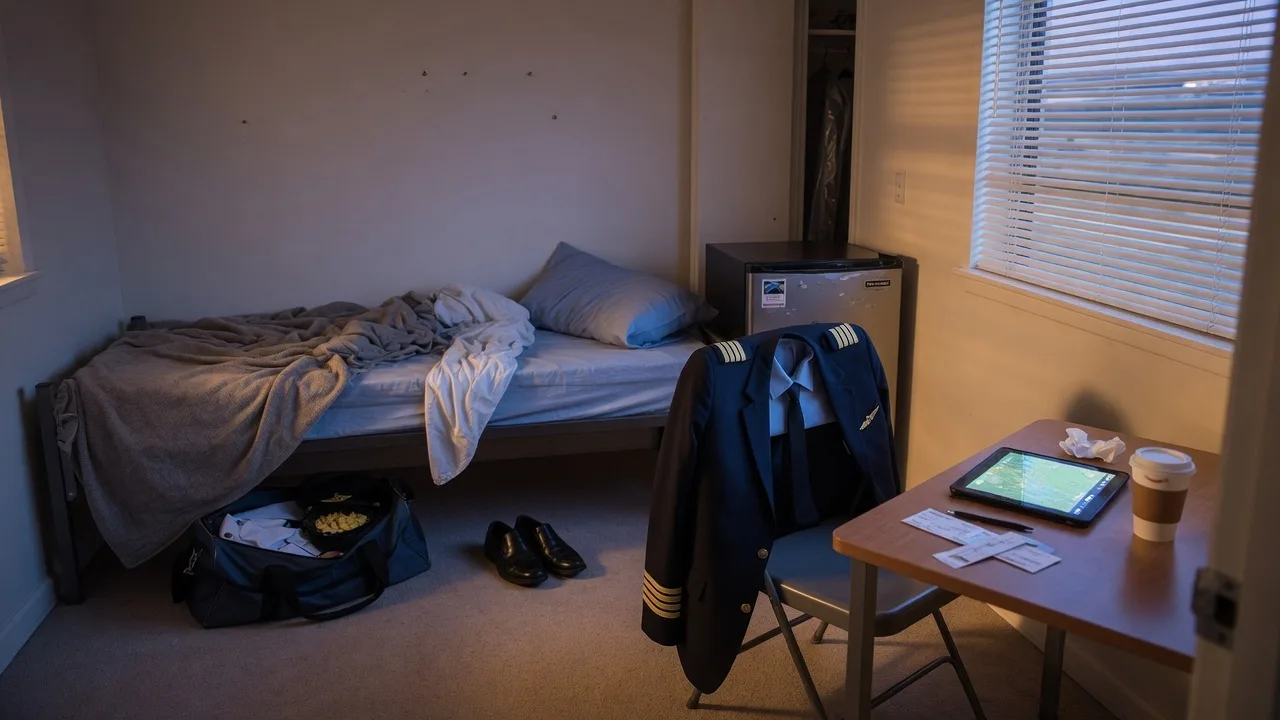
The crash pad gets the job done. It gives you a place to sleep between trips and a location within reach of the airport during reserve. But it is not home. The sleep quality is lower, the space is shared, and the psychological cost of living out of a bunk for days or weeks at a time is real. Many pilots describe it as living in a state of suspended animation, never fully present at base or at home.
When I have talked with pilots who have done both reserve in base and reserve as a commuter, the contrast is stark. The in-base pilot sleeps in their own bed, wakes up when the call comes, drives to the airport, and works the trip. The commuter on reserve has already been away from home for days, sleeping in a shared room, eating out of a cooler, and waiting. Both pilots are doing the same job. Their experience of it could not be more different.
The ready-reserve premium
Some bases offer ready-reserve assignments where pilots report to the airport and wait in the ready room for an assignment. These positions pay a premium for the inconvenience and the availability. An in-base pilot can take a ready-reserve shift, earn the premium, and drive home when the shift ends. A commuting pilot can technically take ready-reserve too, but the economics are different. They are already at the airport because they cannot be anywhere else. The premium they earn is offset by the fact that they are already living away from home just to be on reserve.
The short-call premium is another revenue stream that favors the in-base pilot disproportionately. A short-call trip posts at 2 AM for a 6 AM report. The pilot living twenty minutes from the airport accepts it and earns premium pay on top of the trip value. The commuter sees it on their tablet at 2 AM while lying in a crash pad bunk three miles from the airport, takes the assignment, and earns the same premium. In that narrow moment the outcome is the same. But the commuter was already sleeping at the crash pad because they could not be home. The in-base pilot was asleep in their own house next to their spouse. The premium income is identical. The quality of life around it is not.
Reserve fatigue is different for commuters
The fatigue that a commuting pilot carries on reserve is not the same as the fatigue an in-base pilot feels. Both pilots are at the mercy of the schedule. But the commuter is also managing the logistics of living away from home, the poor sleep quality of a crash pad, the emotional weight of being absent from family, and the constant low-level anxiety of whether the next call will create a scheduling problem on the other end.
That kind of fatigue is cumulative. It does not go away after a good night's sleep. It builds across weeks and months, and it reshapes how a pilot shows up at work and at home. The in-base pilot on reserve might be tired. The commuting pilot on reserve is tired in a different way, and the difference matters for performance, health, and relationships.
I am not saying every pilot should move to base just to make reserve easier. For some pilots, the commute is the right call for reasons that have nothing to do with short-term convenience. A spouse with a strong career, a child in their final school years, or a housing market that punishes the move are all legitimate reasons to stay put. But I want pilots who are making that decision to understand what reserve actually looks like from the commuter side. Not the theory. The day-to-day reality of living out of a crash pad while your family lives at home.
Reserve life is not the same for everyone
The Base Trade Decision Calculator on the Tools page lets you input your current reserve situation and compare what it would look like if you lived in base. The goal is clarity, not persuasion. If the answer is to commute, I will help you make it work.
Open the calculatorFrequently Asked Questions
Can a commuting pilot hold a line and avoid reserve altogether?
Yes, once you hold enough seniority to hold a regular line in your base, the reserve constraint goes away. At that point the commute becomes about positioning for scheduled trips rather than waiting for calls. The question is how long it takes to reach that seniority in your specific base, and whether the years of reserve life are manageable as a commuter.
Do crash pads affect reserve callout compliance?
Crash pads are designed for this purpose. They are located near the airport so that crew members can meet callout times. The risk is not compliance, it is the quality of rest. A crash pad bunk in a shared room with rotating schedules does not deliver the same restorative sleep as your own bed, and that difference compounds over consecutive reserve days.
Is reserve life harder at certain bases for commuters?
Yes. Bases with short callout windows and high reserve utilization create more pressure on commuting pilots. Bases with long callout windows give commuters more flexibility to position themselves. The specific callout time in your CBA combined with your base's reserve culture determines how manageable the commute actually is.
What is the most common mistake new hires make regarding reserve and where to live?
The most common mistake is assuming reserve is temporary and therefore not worth planning around. New hires often choose a crash pad thinking they will hold a line within a few months, and then spend a year or more on reserve. The cumulative cost of that year, in money, sleep, and family presence, is much higher than most pilots estimate when they first bid for their base.
Key takeaways
- Reserve life is not the same experience for in-base pilots and commuters. The practical difference goes beyond crash pad costs and reaches into sleep quality, family presence, and the cumulative fatigue that shapes how you perform at work and at home.
- If you choose to commute on reserve, optimize for it. Pick a crash pad with reliable transportation to the airport, bid for longer sequences when you hold enough seniority, and track the real cost of reserve away from home. The decision to commute should be a conscious choice, not a default.
- Revisit the reserve decision as your seniority changes. A base trade that makes no sense during your first year on reserve may be worth a second look once you can hold a line. The tools on this site can help you evaluate the trade-off at each stage.
Join the conversation in Pilots Base Trading Hub
Reserve life and commuting are regular topics in the group. Pilots share their experiences, compare crash pad options, and help each other think through the decision at every seniority level.
Join the group